
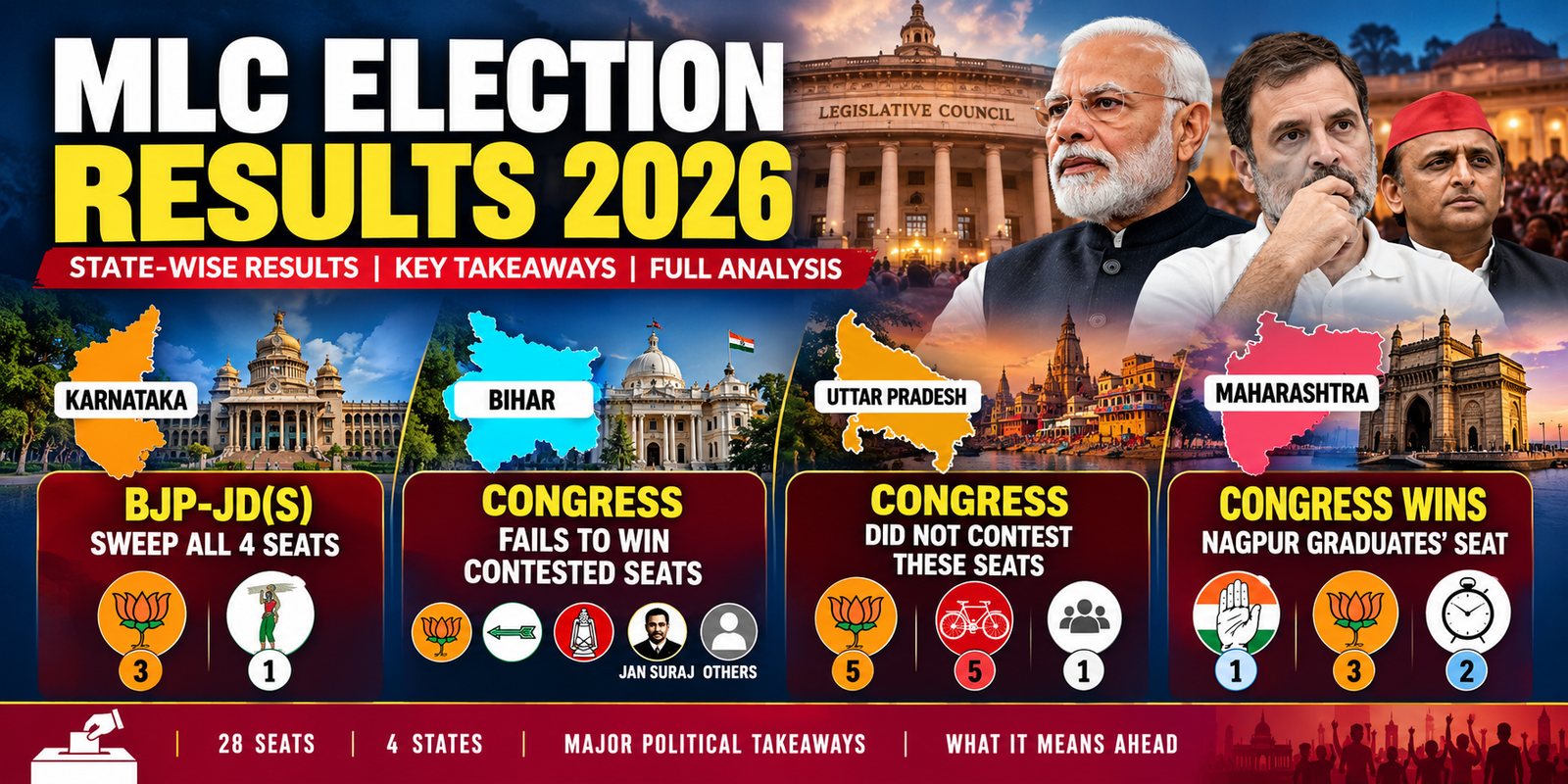
MLC Election Results 2026: Four States, 28 Seats and a Major Test for Congress
An in-depth political report | 29 October 2026
1. Election overview: What happened?
The biennial Legislative Council elections covered 28 seats across Karnataka, Bihar, Uttar Pradesh and Maharashtra. Voting took place on 23 October, with counting beginning on 27 October and continuing into the following day in several constituencies.
The elections were conducted using ballot papers and involved registered graduates and teachers in designated constituencies, rather than the entire electorate that votes in a Lok Sabha or Assembly election.
According to the Indian Express's 28 October report, Congress had failed to win any of the 12 seats it contested at that stage. However, the Nagpur Graduates' constituency in Maharashtra subsequently saw a dramatic reversal in counting, with sitting Congress MLC Abhijit Wanjari claiming victory. The final official result and margin need to be confirmed before declaring Congress's overall final tally.
Source: The Indian Express — MLC election results and Congress's performance.
2. State-wise results and political developments
Karnataka: BJP–JD(S) alliance wins all four seats
Karnataka produced the most politically significant setback for Congress. The BJP won three seats and its ally, the Janata Dal (Secular), won the Bengaluru Teachers' constituency, defeating Congress incumbent Puttanna.
ConstituencyWinnerReported margin or votesBengaluru TeachersA. P. Ranganath, JD(S)10,810 votes against Puttanna's 9,902; margin 908West GraduatesS. V. Sankanur, BJPWon by 9,323 votesNorth-East TeachersShashil G. Namoshi, BJPWon by 3,297 votesSouth-East GraduatesK. M. Suresh, BJP66,020 votes against Congress candidate's 42,922
Source: The Indian Express — Why Congress lost the plot in Karnataka.
Why this result matters
Congress governs Karnataka, so losing all four seats raises questions about its ability to mobilise registered teachers and graduates. The defeat in Bengaluru Teachers is especially notable because Congress lost a seat it had won in a 2024 by-election.
The BJP and JD(S) also demonstrated the electoral value of coordination. Instead of splitting the opposition vote between two candidates, they competed as an alliance.
Karnataka Congress president B. K. Hariprasad acknowledged the challenge posed by the combined opposition. Deputy Chief Minister D. K. Shivakumar said the party had expected to win two seats and would review the outcome.
These are documented indications of an organisational setback, but they do not establish that Karnataka's wider electorate has turned against Congress.
Bihar: Congress fails to convert its candidate presence into victories
Bihar's eight-seat contest produced victories for several different political forces, including the BJP, JD(U), RJD, Jan Suraaj and independent candidates.
One important result was the defeat of sitting Congress MLC Madan Mohan Jha in the Darbhanga Teachers' constituency. Jan Suraaj candidate Suresh Prasad Rai defeated him by 324 votes, giving Prashant Kishor's party representation in the Legislative Council.
Congress contested five of the eight seats and did not secure a victory in the reported results.
Why this result matters
The Darbhanga contest is particularly relevant because a party that is relatively new to legislative representation managed to defeat an established Congress politician in a specialised electorate.
The narrow margin also matters: a 324-vote difference does not, by itself, demonstrate a sweeping rejection of Congress. It points instead to a closely contested constituency in which candidate networks, voter outreach and preference transfers can be decisive.
The broader question for Congress is why it could not convert its existing political presence and candidate experience into a win.
Uttar Pradesh: Congress did not contest these seats
Uttar Pradesh had 11 Legislative Council seats in the election cycle. The BJP and Samajwadi Party won seats, with the BJP securing five and the SP also securing five in the final reported state-wise tally, while one seat's details need to be read alongside the constituency-specific results.
Crucially, Congress did not field candidates in these MLC contests, according to the Indian Express's 28 October report.
This distinction matters when evaluating the claim that Congress won zero seats. Congress cannot be described as having lost every contest in Uttar Pradesh if it did not contest those seats.
Political significance
The results provide information about the BJP and SP's strength among the registered teacher and graduate electorate. They do not measure Congress's vote share in these constituencies because the party was absent from the ballot.
The upcoming Assembly election is a separate contest with a much larger and different electorate. These MLC results should not be treated as a direct forecast of that election.
Maharashtra: The Nagpur counting drama complicates the zero-seat narrative
Maharashtra held elections for five Legislative Council constituencies: three graduates' constituencies and two teachers' constituencies.
The BJP-led Mahayuti secured victories in three seats, while the opposition NCP (Sharadchandra Pawar) won two. The BJP won the Pune Teachers' constituency, and Shiv Sena candidate Kiran Sarnaik won the Amravati Teachers' constituency. NCP (SP) candidates won the Pune Graduates' and Chhatrapati Sambhajinagar Graduates' seats.
The Nagpur Graduates' contest was the major unresolved race in reports published on 28 October.
BJP candidate Sudhakar Kohale held a lead during part of the count, but Congress incumbent Abhijit Wanjari later claimed victory. The Live Nagpur reported that Kohale acknowledged the trend appeared to be moving in Congress's favour, while official confirmation of the final tally and margin was still pending in that report.
Sources:
Why Nagpur matters
The contest illustrates the importance of preference transfers in these elections. A candidate can lead during an early round and still lose once lower-ranked candidates are eliminated and their preferences are transferred.
It also shows why preliminary seat counts must not be reported as final results. If Wanjari's victory is officially confirmed, the claim that Congress won zero seats across the four-state cycle would be incorrect.
3. Why did Congress struggle? A deeper analysis
The election results support several possible explanations. These should be treated as analytical interpretations, not as proven causes in the absence of detailed constituency-level evidence.
A. Organisational mobilisation
Graduates' and teachers' constituencies require targeted outreach. Candidates must connect with registered voters, maintain contact lists, mobilise supporters and understand local professional concerns.
Congress's losses in Karnataka and Bihar raise questions about whether its local organisation was sufficiently effective in these electorates.
A party's strength in a general election does not automatically translate into a strong network among teachers or registered graduates.
B. Opposition coordination
The BJP–JD(S) alliance's sweep of Karnataka demonstrates the practical advantage of coordinated candidate selection and campaigning.
The alliance won all four seats, with the BJP retaining three and JD(S) winning the fourth. The Bengaluru Teachers' result suggests that opposition coordination was an important feature of the contest.
However, one election cycle is not enough to quantify how much of the result came from alliance coordination versus candidate popularity or local circumstances.
C. Candidate-specific weaknesses
The results were not uniform across all constituencies. Some contests were decided by narrow margins, while others produced larger differences.
In Darbhanga, Congress's sitting MLC lost by just 324 votes. In Bengaluru, Puttanna lost by 908 votes. These outcomes are consistent with competitive, constituency-level contests rather than a single uniform explanation for every defeat.
To establish whether candidate selection was a major cause, the party would need to examine previous results, local voter feedback, campaign activity and the performance of rival candidates.
D. Difficulty converting government incumbency into electoral support
Karnataka is the clearest case because Congress was the ruling party but failed to win any of the four seats.
This raises a legitimate question about whether the party's state-level political organisation translated its governing position into support among registered teachers and graduates.
It does not prove that government performance alone caused the losses. The BJP–JD(S) alliance, the specific constituencies, candidates and electoral mechanics also matter.
E. The challenge from regional and emerging parties
The Bihar result offers a reminder that Congress faces competition not only from the BJP but also from other opposition parties.
Jan Suraaj's victory in Darbhanga demonstrated that an emerging political organisation could win a Legislative Council seat at Congress's expense.
Regional political forces can attract voters through local relationships, issue-specific campaigning and candidate credibility. Their impact differs by state and constituency.
4. Does the result weaken Congress's criticism of EVMs?
The BJP used the ballot-paper results to criticise Congress and Rahul Gandhi's claims about electronic voting machines. Prime Minister Narendra Modi publicly highlighted Congress's reported failure to win any of the 12 seats it contested.
The political argument is straightforward: if Congress argues that ballot papers are preferable to EVMs, its defeats in ballot-paper elections invite questions about whether voting technology explains its electoral performance.
But the evidence has limits.
These MLC elections used ballot papers, and Congress lost several contests. That fact does not independently prove or disprove claims about EVM security in other elections.
The elections involved specialised electorates, different candidates and local political arrangements. A result in one type of election cannot, on its own, settle broader questions about the integrity of another electoral process.
The ballot-paper argument is therefore politically relevant but should not be mistaken for a comprehensive technical assessment of EVMs.
5. What these results do — and do not — tell us
QuestionWhat the evidence supportsDid Congress suffer a setback?Yes, particularly in Karnataka and Bihar.Did the BJP–JD(S) alliance sweep Karnataka?Yes, it won all four seats.Did Congress contest all 28 seats?No. It contested 12 according to the Indian Express report; it did not field candidates in the Uttar Pradesh contests.Did Congress definitely finish with zero seats overall?Not established by the latest reports reviewed, because the Nagpur result was still being finalised in the available coverage.Does the result prove Congress has lost support among all voters in these states?No. The electorate consisted of registered graduates and teachers in designated constituencies.Does it predict the next Assembly elections?No direct prediction can be drawn from these results alone.
6. What should Congress examine next?
A meaningful post-election review would need to move beyond public statements and slogans.
- Constituency-level vote analysis: Compare current and previous results, margins, invalid ballots and preference transfers.
- Voter mobilisation: Examine registration, turnout, contact rates and campaign coverage among eligible teachers and graduates.
- Candidate selection: Assess candidates' local credibility, professional networks and voter feedback.
- Alliance strategy: Identify where opposition coordination affected the result and where rival parties competed against each other.
- Local issue research: Determine which concerns influenced teachers and graduates instead of assuming that general political narratives drove their votes.
- Follow-through: Publish a concrete review of the losses and identify changes in organisation, outreach and candidate preparation.
Without this evidence, attributing the outcome entirely to leadership, government performance, ideology or voting technology would go beyond what the results establish.
Conclusion
The 2026 MLC elections have exposed real challenges for Congress, especially in Karnataka, where the ruling party lost all four seats to the BJP–JD(S) alliance. Bihar also produced a setback, including the defeat of a sitting Congress MLC by Jan Suraaj.
At the same time, the four-state results were not a single, uniform verdict. Uttar Pradesh involved no Congress candidates in the reported MLC contests, and Maharashtra's Nagpur Graduates' race remained unsettled in the latest verified reports.
The most defensible conclusion is that Congress needs to examine its performance in these specialised electorates, strengthen local mobilisation and assess its candidate and alliance strategies. The results are politically significant, but they should not be exaggerated into proof of a nationwide collapse or a definitive prediction of future Assembly outcomes.




Comments