
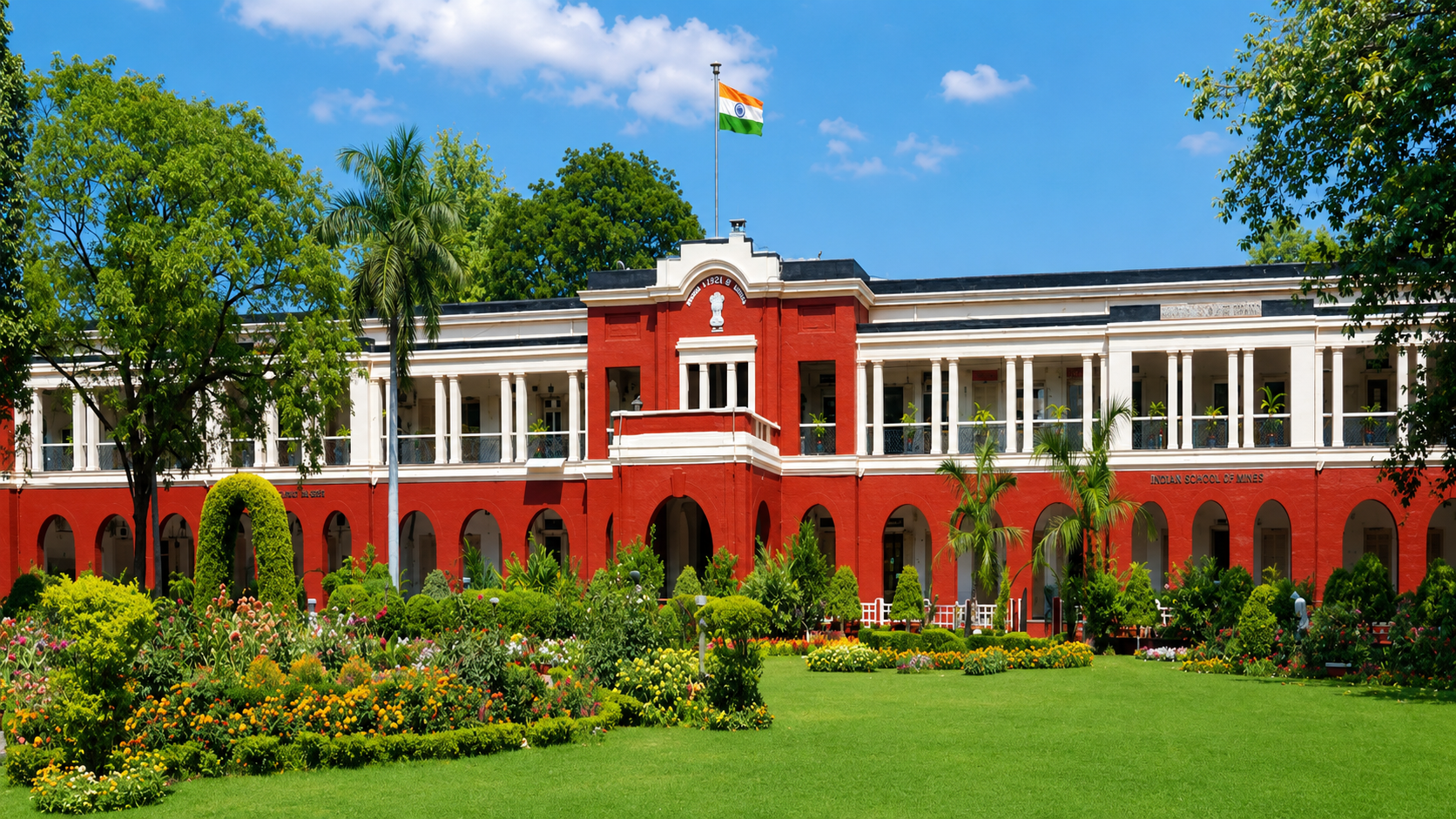
A Dream Born from India's Mineral Wealth
The story begins in the early 20th century.
India was rich in minerals, but poor in trained mining professionals. Coal production was increasing rapidly to power railways, industries, and steel plants, yet most technical expertise came from foreign engineers.
Recognizing the need for an institution dedicated to mining education, the British Government decided to establish a college on the lines of the Royal School of Mines, London.
The ideal location was obvious—Dhanbad.
Surrounded by the rich coal reserves of the Jharia Coalfield, Dhanbad provided students with something no classroom alone could offer: real mines, real geology, and real industrial experience.
Thus, in 1926, the Indian School of Mines (ISM) was established, marking the beginning of one of India's greatest educational journeys.
Why Dhanbad Was the Perfect Choice
Dhanbad was already becoming the center of India's coal industry.
The city offered everything a mining institution required:
- Vast coal reserves
- Active underground and open-cast mines
- Experienced mining engineers
- Geological diversity
- Railway connectivity
- A thriving industrial ecosystem
Students didn't just study mining—they experienced it firsthand.
Field visits to working mines became part of learning, allowing students to understand the practical challenges of mining long before entering the workforce.
Building the Nation's Mining Engineers
From its earliest days, ISM earned a reputation for producing highly skilled mining professionals.
Its curriculum combined rigorous academic education with extensive practical training.
Over the decades, students specialized in:
- Mining Engineering
- Geology
- Applied Geophysics
- Petroleum Engineering
- Mineral Engineering
- Mechanical Engineering
- Electrical Engineering
Graduates went on to manage some of India's largest mines and contributed significantly to the growth of industries such as coal, iron ore, steel, oil, and natural gas.
Many of India's major mining projects have been led by engineers who began their journey in the classrooms of ISM.
Beyond Mining: A Modern Centre of Excellence
As technology evolved, so did the institution.
While mining remained its foundation, ISM expanded into new disciplines, transforming itself into a multidisciplinary engineering university.
Today, IIT (ISM) offers programs in:
- Computer Science and Engineering
- Artificial Intelligence
- Data Science
- Electronics Engineering
- Civil Engineering
- Chemical Engineering
- Environmental Engineering
- Mathematics
- Physics
- Management Studies
This evolution has enabled the institute to contribute not only to mining but also to emerging technologies shaping the future.
A Campus Rich in Heritage
Spread across a lush green campus in the heart of Dhanbad, IIT (ISM) beautifully blends history with modern infrastructure.
Its tree-lined avenues, heritage buildings, state-of-the-art laboratories, hostels, sports complexes, libraries, and research centers create an environment where tradition meets innovation.
The campus has witnessed generations of students pursuing excellence, many of whom have gone on to become industry leaders, scientists, entrepreneurs, and policymakers.
The Historic Transformation into an IIT
A defining moment in the institution's history came in 2016.
The Government of India upgraded the Indian School of Mines to an Indian Institute of Technology, officially renaming it IIT (ISM) Dhanbad.
The upgrade brought greater research opportunities, improved infrastructure, international collaborations, and enhanced academic recognition.
Yet, even after becoming an IIT, the institute proudly retained the "ISM" identity—a tribute to nearly a century of excellence in mining education.
Driving Research and Innovation
Today, IIT (ISM) is one of India's leading research institutions.
Its faculty and researchers work on cutting-edge technologies in areas such as:
- Sustainable mining
- Artificial Intelligence
- Robotics
- Earthquake engineering
- Clean energy
- Mineral exploration
- Petroleum technology
- Climate science
- Environmental sustainability
- Smart mining systems
Many of these innovations directly benefit industries across India and contribute to solving global challenges.
Alumni Who Changed Industries
The strength of IIT (ISM) lies in its alumni.
Its graduates have gone on to serve in prestigious organizations including:
- Coal India Limited
- Bharat Coking Coal Limited (BCCL)
- ONGC
- Tata Steel
- Steel Authority of India (SAIL)
- ISRO
- DRDO
- Microsoft
- Shell
- Rio Tinto
- BHP
Many have become CEOs, researchers, professors, entrepreneurs, civil servants, and innovators, carrying the legacy of Dhanbad across the globe.
A Source of Pride for Dhanbad
For the people of Dhanbad, IIT (ISM) is far more than an educational institution.
It symbolizes:
- Academic excellence
- Scientific innovation
- Engineering leadership
- National development
- Global recognition
Every year, students from every corner of India come to Dhanbad with dreams of becoming world-class engineers, making the city a hub of knowledge alongside its identity as the Coal Capital of India.
Looking Ahead
As the world embraces renewable energy, automation, and digital transformation, IIT (ISM) continues to redefine its role.
Research is now focused on:
- Green mining technologies
- Carbon capture and storage
- Renewable energy systems
- Artificial Intelligence applications
- Robotics in mining
- Sustainable resource management
- Smart infrastructure
The institute remains committed to preparing engineers who can address the challenges of tomorrow while preserving the rich legacy of the past.
Conclusion
The story of IIT (ISM) Dhanbad is not just the story of a college—it is the story of India's industrial progress.
For nearly 100 years, the institute has educated generations of engineers who have powered the nation's mines, industries, and technological advancements.
From the coalfields of Jharia to global boardrooms and research laboratories, the influence of IIT (ISM) extends far beyond Dhanbad.
As the city continues to evolve, IIT (ISM) stands as its brightest symbol of knowledge, innovation, and excellence—proving that while coal built Dhanbad's economy, education built its legacy.
Did You Know?
- Indian School of Mines (ISM) was established in 1926, inspired by the Royal School of Mines, London.
- In 2016, it became IIT (ISM) Dhanbad, joining India's prestigious IIT system.
- It is globally renowned for its programs in Mining Engineering, Earth Sciences, Petroleum Engineering, and Applied Geophysics.
- Its alumni have played a vital role in India's mining, energy, infrastructure, and technology sectors.



Comments