
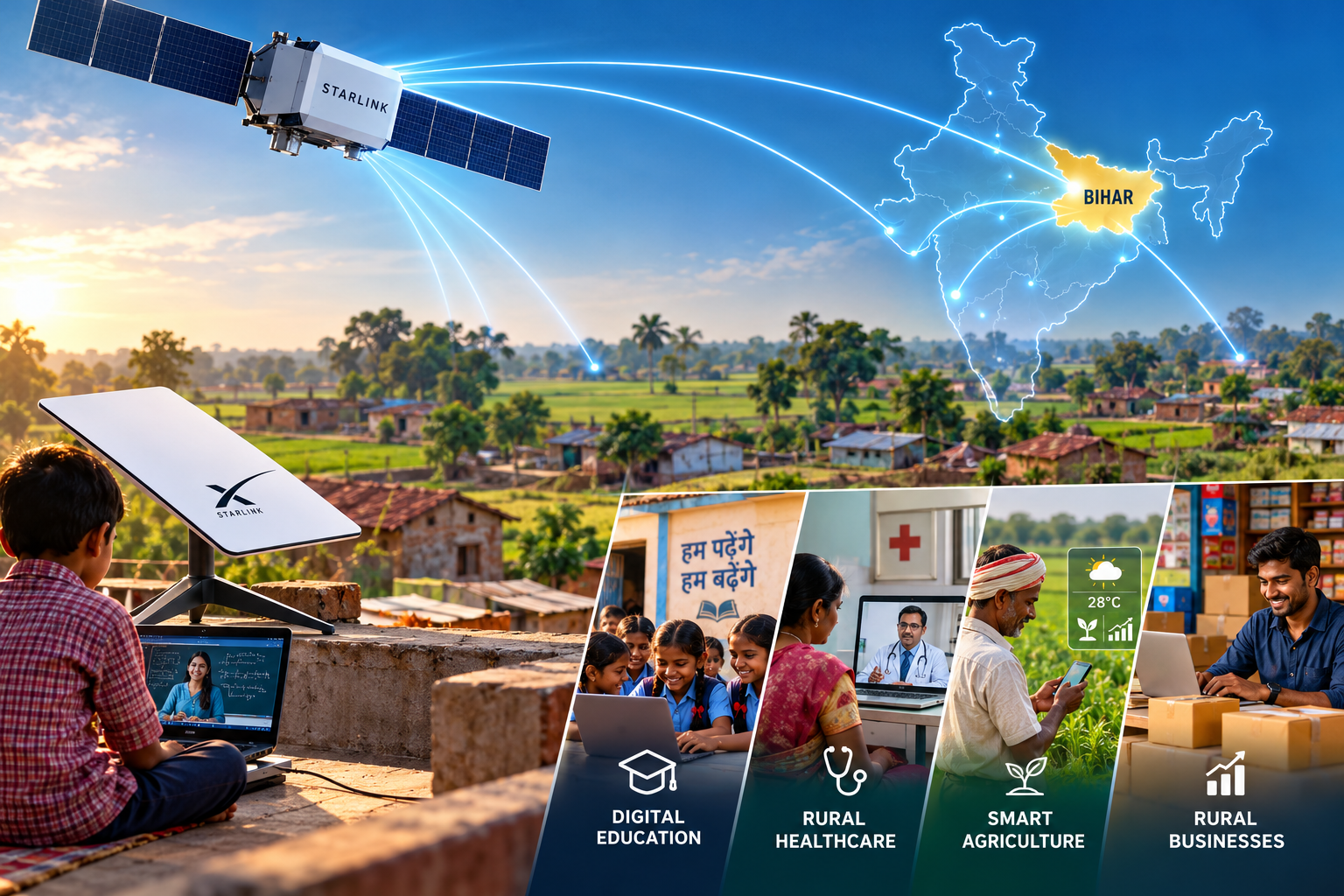
Introduction: A New Possibility for Rural Connectivity
Imagine a student in a village in Bihar attending an online science class without struggling with an unstable internet connection. Imagine a farmer checking market prices on a smartphone, a small business owner managing online orders, or a rural health centre connecting with a specialist in Patna through a video consultation.
These possibilities depend on one essential resource: reliable internet access.
India has expanded its digital infrastructure significantly, but connectivity quality, affordability and access to suitable broadband services can still vary from one location to another. This creates an important question for the future of rural development: can satellite internet help connect communities that conventional networks do not serve adequately?
One technology attracting attention is Starlink, the satellite internet service developed by SpaceX.
Unlike conventional broadband, which often relies on fibre-optic cables or nearby mobile infrastructure, Starlink uses satellites in low Earth orbit to provide internet connectivity through specialised ground equipment.
For Bihar, a state with extensive rural communities and a growing need for digital services, this technology presents an interesting possibility. But its real value will depend on more than satellite technology alone. Availability, affordability, regulation and practical local needs will determine whether it can make a meaningful difference.
What Is Starlink and How Does It Work?
Starlink is a satellite-based broadband system operated by SpaceX. Its network uses satellites orbiting relatively close to Earth to transmit internet data between user equipment and the wider network.
A typical setup involves three main elements:
- Satellite network: Satellites relay data between user terminals and the internet.
- User terminal: Specialised equipment installed at the customer's location communicates with the satellite network.
- Wi-Fi equipment: A compatible router or networking system distributes the connection to devices such as smartphones, laptops and computers.
Because satellite connectivity does not require a fibre cable to reach every individual property, it may offer advantages in locations where building terrestrial infrastructure is difficult or expensive.
However, satellite internet is not automatically faster, cheaper or more reliable than every terrestrial connection. Performance depends on location, network capacity, equipment placement, weather conditions and the service plan.
Why Does Rural Bihar Need Better Internet Connectivity?
Bihar's digital future is closely connected to education, agriculture, healthcare, employment and access to public services.
In many rural communities, people use mobile internet for communication, digital payments, online applications and information. Yet a mobile signal does not always mean that a household has access to reliable, high-capacity broadband.
The distinction matters. A connection suitable for messaging may not consistently support several people attending online classes, uploading large files or participating in video conferences.
Satellite broadband could provide another option in places where existing mobile and fixed broadband services do not meet local requirements.
1. Education: Bringing Digital Learning Closer to Students
Students increasingly rely on digital learning materials, online examinations, recorded lectures and remote classes.
A school with a dependable internet connection could provide access to educational resources that are difficult to obtain locally. Teachers could use interactive learning platforms, while students could participate in online classes and develop digital skills.
In a hypothetical rural Bihar school where terrestrial broadband is unreliable, satellite internet might provide an alternative connection if the service is available and affordable.
But connecting a school is only the beginning. Schools also need electricity, computers or tablets, trained teachers, appropriate learning content and a plan for maintaining the equipment.
The opportunity: satellite broadband could help extend digital education to underserved locations when combined with the resources students need to benefit from it.
2. Agriculture: Supporting More Informed Decisions
Agriculture remains an important part of Bihar's economy and rural livelihoods.
Farmers can benefit from timely access to weather forecasts, agricultural advisories, market prices, government schemes and information about crop management.
Reliable connectivity may also help agricultural cooperatives, rural entrepreneurs and farmer-producer organisations coordinate logistics and communicate with buyers.
For example, a farmer or cooperative could use online services to compare market prices before arranging transportation for produce.
However, Starlink does not directly increase crop yields or guarantee better prices. Its contribution would be to provide connectivity that helps people access useful information and services.
For satellite broadband to become practical for individual farmers, the total cost would need to make sense for their income and usage requirements. Shared connections at agricultural centres or community facilities could be another model worth evaluating.
3. Rural Healthcare: Improving Access to Remote Consultations
Access to specialist healthcare can be challenging for people who live far from major hospitals.
Reliable internet can support telemedicine consultations, digital medical records, remote training for health workers and the transfer of information between healthcare facilities.
A rural health centre with a dependable connection could potentially consult specialists in a larger city when appropriate medical services are available.
Satellite broadband could be considered where terrestrial connectivity is insufficient. Nevertheless, medical staff, patient privacy, suitable equipment, emergency transport and reliable electricity remain essential.
Internet access can support healthcare delivery, but it cannot replace physical examinations, emergency treatment or medical infrastructure where those are necessary.
4. Rural Businesses: Creating New Economic Opportunities
Internet access can help small businesses reach customers outside their immediate locality.
A local retailer could manage digital payments and online listings. A handicraft producer could promote products to buyers in other states. A tourism business could manage reservations, and a service provider could communicate with clients remotely.
For entrepreneurs in smaller towns and villages, reliable connectivity can reduce some barriers to participating in the digital economy.
Satellite internet may be particularly relevant to businesses operating in locations without suitable fixed broadband.
The commercial question is whether its installation and monthly operating costs are justified by the business's needs. For many small businesses, existing mobile data or fibre broadband may remain more economical.
5. Employment: Expanding Access to Online Work
Remote work, online training and digital freelancing can create opportunities for people who cannot easily relocate to larger cities.
A stable connection can help users attend virtual interviews, complete training programmes, communicate with clients and submit work online.
For young people in Bihar, improved connectivity could make a wider range of learning and employment resources accessible.
However, connectivity alone does not guarantee employment. Professional skills, language ability, suitable devices, payment access and job availability remain important factors.
Could Starlink Help Bihar's Remote and Underserved Locations?
The potential value of satellite internet is not uniform across the state.
Some locations already have access to mobile broadband or fibre connections. In these areas, Starlink would need to demonstrate a practical advantage to justify any additional equipment and subscription costs.
Other locations may face persistent connectivity difficulties because of their distance from existing infrastructure or the challenges of maintaining a reliable terrestrial network.
Satellite connectivity could be worth assessing in several settings:
Potential use casePossible benefitImportant considerationRural schoolsAccess to digital learning platformsDevices, electricity and maintenancePrimary health centresSupport for telemedicineMedical staff and patient privacyAgricultural cooperativesAccess to market and weather informationAffordability and shared accessRural businessesOnline sales and digital operationsBusiness case and monthly costCommunity centresShared access to online servicesFair access and local managementEmergency-response locationsAn additional communication optionPower backup and network availability
These are potential applications, not confirmed Starlink deployments in Bihar.
A practical approach would be to identify locations where existing internet services are inadequate, compare available technologies and test whether satellite broadband delivers a measurable improvement.
Starlink vs Jio, Airtel and Fibre Broadband
Starlink would enter a market already served by established telecom operators, including Jio and Airtel, alongside other broadband providers and government-supported connectivity initiatives.
The important question is not whether one technology is universally superior. It is which technology best serves a particular location and purpose.
FeatureStarlink satellite internetFibre broadbandMobile internetConnection methodSatellites and user terminalFibre-optic cablesMobile network towersPhysical connection to each propertySatellite terminal requiredFibre installation requiredUsually a compatible phone or hotspotPotential advantageLocations with limited terrestrial infrastructureHigh-capacity fixed connections where availableMobility and widespread everyday useInitial equipmentDedicated terminal and networking equipmentModem or router and installationSmartphone or mobile hotspotCost considerationsHardware and subscription costsPlan and installation costsData plan and device costsBest fitSelected underserved or remote locationsHomes and businesses with suitable coverageMobile use and locations with good coverage
In an urban area with affordable fibre broadband, Starlink may offer little financial advantage to a typical household.
In a remote location where fibre is unavailable and mobile connectivity is inadequate, satellite broadband may be a more useful alternative if service is commercially available.
For Bihar, the goal should be to expand meaningful connectivity by choosing the appropriate technology for each community rather than treating satellite internet as a universal replacement for existing networks.
What Is the Current Status of Starlink in India?
Starlink's progress in India is an important factor in determining when these potential benefits could become practical.
The Government of India announced on 29 January 2026 that Starlink Satellite Communications Private Limited had received a Unified Licence with authorisation for satellite communication services. The government also identified satellite communications as a potential way to serve rural, underserved, remote, coastal, border and mountainous areas. Source: Press Information Bureau.
However, a licence does not automatically mean that consumers can immediately purchase and activate a commercial service.
As of 11 October 2026, recent reporting indicates that satellite operators, including Starlink, are still awaiting outstanding requirements involving spectrum allocation and security clearances before commercial operations can begin. The government says the relevant regulatory process applies to the licensed operators. Source: Reuters, 8 October 2026.
Therefore, residents of Bihar should check official announcements before making purchasing decisions. An announcement about licensing, an expected launch or a proposed partnership should not be interpreted as confirmation of active commercial coverage.
How Much Could Starlink Cost in Bihar?
Affordability may be one of the biggest factors determining whether satellite internet becomes useful for ordinary rural households.
The total cost can include:
- Equipment: The initial purchase of a compatible satellite terminal and networking equipment.
- Subscription: The recurring monthly charge for internet access.
- Installation: Any applicable setup, mounting or installation expenses.
- Taxes and additional charges: Amounts that depend on the final local offer and terms.
As of the article's publication date, readers should verify official India-specific consumer pricing and availability rather than rely on prices quoted in other countries or unverified social media posts.
A high initial equipment cost could discourage households even if the monthly service is attractive.
One possible alternative is shared access. A school, community centre, cooperative or business could potentially provide connectivity to multiple users, subject to the provider's terms, applicable regulations and the facility's technical capacity.
This model would need to be evaluated carefully. Shared access requires fair usage policies, appropriate network equipment, security measures and a sustainable way to pay for the service.
For widespread rural adoption, the relevant measure is not simply internet speed. It is the cost of providing a reliable and useful connection to the people who need it.
Challenges That Could Limit Starlink's Impact
Although satellite internet presents opportunities, several practical challenges must be considered.
Regulatory and Security Requirements
Satellite communication services must meet India's applicable licensing, spectrum and security requirements. Commercial availability depends on satisfying those requirements.
Affordability for Rural Households
Equipment and subscription costs may be difficult for some households to justify, particularly where lower-cost alternatives already work adequately.
Power Supply
Satellite terminals and Wi-Fi equipment need electricity. Locations with unreliable power may require backup systems, increasing the total cost.
Installation and Obstructions
The terminal needs a suitable view of the sky. Buildings, trees and other obstructions can affect connectivity, and installation may require an appropriate mounting location.
Local Technical Support
Users need help with installation, troubleshooting, maintenance and equipment replacement. Service providers and local support arrangements could influence long-term reliability.
Existing Broadband Infrastructure
Government-supported fibre expansion and terrestrial telecom networks already play important roles in rural connectivity. Satellite broadband should be evaluated alongside these alternatives, not in isolation.
Digital Literacy
A reliable internet connection has limited value if people lack suitable devices, digital skills or access to relevant services.
These challenges do not eliminate the potential of satellite internet, but they demonstrate why a successful rural connectivity strategy requires more than deploying new technology.
Starlink and the Future of Digital India
India's digital future will depend on multiple technologies working together.
Fibre networks can deliver high-capacity broadband where installation is practical. Mobile networks provide convenient access to a large number of users. Satellite systems may help extend connectivity to places where terrestrial infrastructure is insufficient.
Government initiatives such as BharatNet are also intended to expand broadband infrastructure and improve rural access. Satellite internet could complement these efforts in locations where it provides a practical benefit. Source: Government of India, Digital Infrastructure Upgradation in Villages.
For Bihar, the most meaningful outcome would be improved access to education, healthcare, employment, government services and economic opportunities.
That outcome should be measured through practical results: more reliable school connectivity, better access to digital services, affordable internet for underserved communities and sustainable operating costs.
The introduction of a new technology is only the beginning. Its real value comes from whether people can use it consistently and affordably.
What Should Bihar's Households and Businesses Do Now?
Until commercial availability and local pricing are officially confirmed, prospective customers should avoid making decisions based on rumours or unofficial offers.
A few practical steps can help:
- Check whether existing mobile broadband or fibre providers can meet your needs.
- Identify whether the problem is poor coverage, low speed, unreliable service or high cost.
- Follow official Starlink announcements and Indian government updates.
- Compare the complete cost of equipment, installation and recurring service before purchasing.
- For schools and community facilities, consider shared connectivity options and the resources needed to support users.
- Verify any seller or booking offer through official channels.
For many users, improving an existing connection may be more economical than switching technologies. For locations with persistent coverage problems, satellite internet could be worth evaluating when authorised services become available.
Conclusion: A Potential Opportunity, Not a Guaranteed Solution
Starlink could become a useful addition to India's connectivity ecosystem, particularly in locations where conventional broadband services cannot adequately meet local needs.
In rural Bihar, the potential applications include digital education, telemedicine, agricultural information, online business operations and access to remote employment resources.
But the technology's actual impact will depend on regulatory approval, commercial availability, affordability, reliable power, local support and the needs of individual communities.
Starlink should therefore be viewed as one possible part of a broader digital infrastructure strategy. Fibre, mobile broadband, satellite connectivity and public digital services can all contribute in different ways.
The real question is not simply whether Starlink can bring the internet to rural Bihar. It is whether reliable, affordable connectivity can help people in Bihar turn internet access into better opportunities.
If satellite broadband can help close that gap, its significance could extend far beyond faster downloads. It could become part of a larger effort to make India's digital future more accessible to rural communities.
Frequently Asked Questions
Is Starlink available in Bihar?
As of 11 October 2026, outstanding regulatory requirements are still reported to be pending before commercial operations can begin. Check official announcements for the latest status.
Can Starlink provide internet in villages?
Satellite internet may be suitable for villages where terrestrial connectivity is inadequate, provided the service is authorised and commercially available at the location.
Will Starlink be cheaper than Jio or Airtel?
That cannot be determined without confirmed local pricing and a comparison of equipment, subscription costs, data requirements and service quality.
Can schools in rural Bihar use Starlink?
Potentially, if commercial service becomes available and the school can afford the equipment and subscription. Schools would also need electricity, suitable devices and staff support.
Can farmers benefit from satellite internet?
Reliable internet could help farmers access weather forecasts, market information, agricultural resources and online services. The benefits would depend on affordability and the relevance of those services to local needs.
Does Starlink replace fibre broadband?
Not necessarily. Fibre may remain more economical and practical where it is available, while satellite connectivity could serve locations that terrestrial infrastructure does not adequately reach.
When will Starlink launch commercially in India?
A confirmed launch date should be taken from official announcements. Licensing progress alone does not establish a commercial launch date.
Sources and Further Reading
- Government of India — Satellite Communication Services: Licensing information and the potential role of satellite connectivity in underserved areas. https://www.pib.gov.in/PressReleasePage.aspx?PRID=2220346&lang=1®=1
- Reuters — India's satellite internet approval process: Recent reporting on spectrum allocation, security clearances and regulatory developments. https://www.reuters.com/business/media-telecom/india-denies-bias-in-satellite-internet-approvals-after-musks-oligarchs-jab-2026-10-08/
- Government of India — Digital Infrastructure Upgradation in Villages: Information about the BharatNet programme and rural broadband development. https://www.pib.gov.in/PressReleasePage.aspx?PRID=2117923&lang=2®=48
- Starlink official website: https://www.starlink.com/
Editorial note: This article presents original analysis of potential use cases for rural Bihar. Hypothetical examples are illustrative, not reports of confirmed Starlink deployments. Regulatory status, availability and pricing can change and should be verified before publication or purchasing decisions.




Comments