
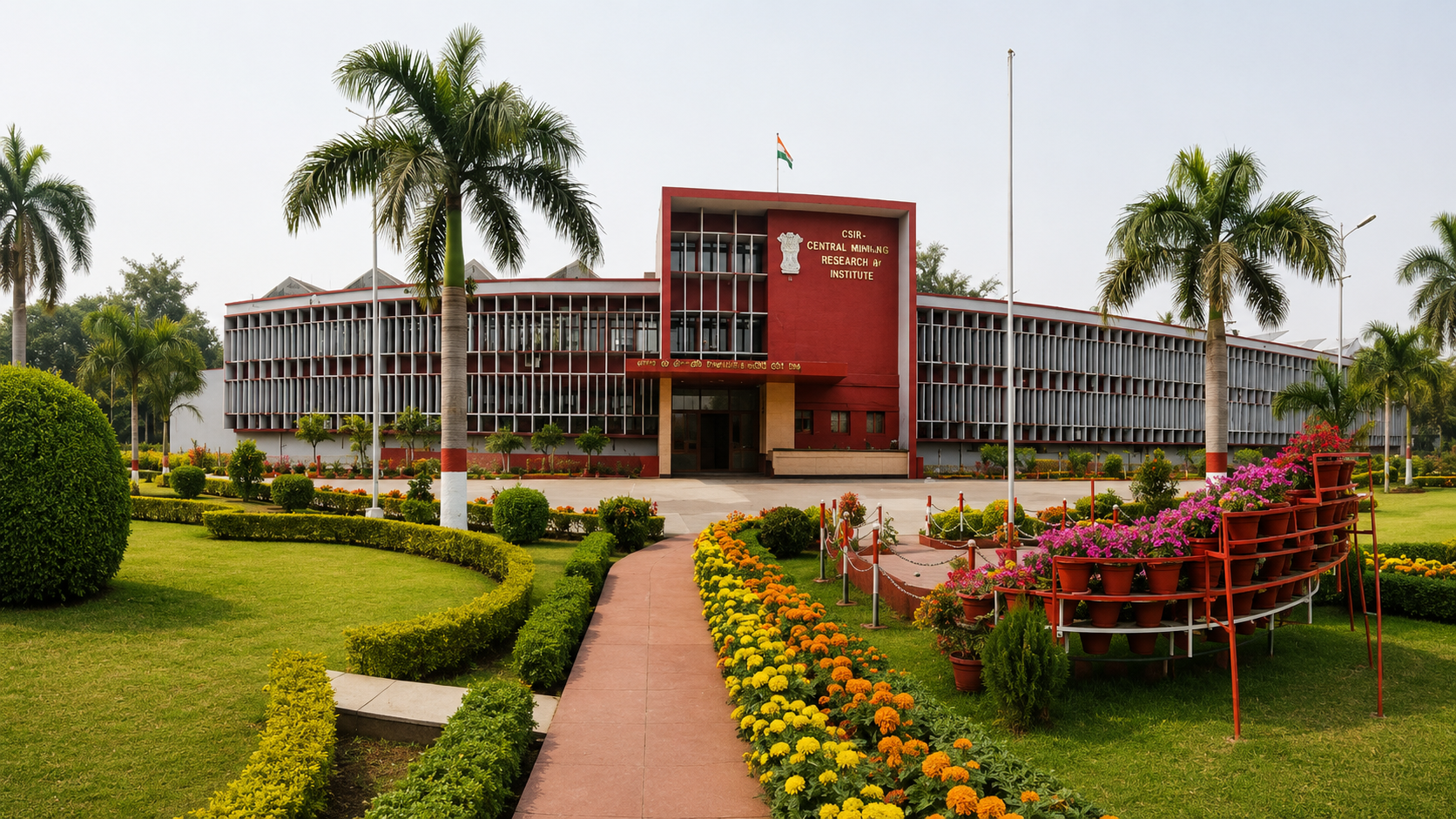
The Need for Scientific Mining
After India gained independence in 1947, the demand for coal grew rapidly. Coal powered railways, steel plants, power stations, and industries that were driving the nation's development.
However, mining during those years was extremely dangerous.
Mine collapses, underground fires, methane explosions, flooding, and coal dust accidents were common. Every year, hundreds of miners risked—and often lost—their lives deep beneath the earth.
India needed more than manpower. It needed science.
Recognizing this challenge, the Council of Scientific and Industrial Research (CSIR) established the Central Mining Research Institute (CMRI) in Dhanbad during the 1950s to develop scientific solutions for the country's growing mining industry.
Why Was CMRI Built in Dhanbad?
The answer was simple—there was no better place.
Dhanbad sits on the rich Jharia Coalfield, home to some of India's finest coking coal reserves. The city was already surrounded by active underground mines, experienced engineers, and one of the country's leading mining institutions, the Indian School of Mines (now IIT (ISM) Dhanbad).
Researchers at CMRI could study real mining conditions instead of relying only on laboratory experiments. New technologies could be tested directly in working mines before being adopted across India.
This close connection between research and industry made Dhanbad the perfect home for India's premier mining research institute.
More Than a Laboratory
Unlike coal companies that extracted minerals, CMRI extracted knowledge.
Scientists, engineers, geologists, chemists, and safety experts worked together to answer questions that affected thousands of miners every day.
They researched topics such as:
- Preventing underground explosions
- Controlling mine fires
- Improving mine ventilation
- Strengthening underground tunnels
- Monitoring dangerous gases
- Rock mechanics and ground stability
- Dust suppression technologies
- Safe blasting techniques
- Mine rescue operations
- Environmental protection
Every successful experiment meant safer working conditions for miners across the country.
Saving Lives Beneath the Earth
Perhaps CMRI's greatest contribution was improving mine safety.
India's underground coal mines have always faced serious hazards. Methane gas can ignite without warning. Coal dust can explode. Weak rock formations can collapse under enormous pressure.
CMRI developed scientific methods to monitor these dangers before they became disasters.
Its researchers designed better ventilation systems, improved roof support technologies, introduced modern monitoring equipment, and developed techniques for controlling underground fires.
Many of these innovations eventually became standard safety practices throughout India's coal industry.
Thousands of miners returned home safely because of research conducted in Dhanbad.
Supporting India's Energy Revolution
Coal has long been India's primary source of energy.
As electricity demand increased and industries expanded, coal production had to grow without compromising safety.
CMRI worked closely with organizations such as:
- Coal India Limited
- Bharat Coking Coal Limited (BCCL)
- Central Coalfields Limited
- Steel Authority of India
- Various public and private mining companies
Researchers solved practical problems faced inside mines, improving productivity while reducing risks.
Their work contributed significantly to India's industrial growth.
Training the Next Generation
CMRI wasn't only a research institute—it became a center for education and technical training.
Mining engineers, scientists, researchers, and industry professionals from across India visited Dhanbad to learn modern mining techniques.
The institute collaborated with universities, government agencies, and mining companies, helping spread scientific knowledge throughout the country.
This exchange of expertise strengthened India's entire mining ecosystem.
The Transformation into CIMFR
In 2007, an important chapter began.
The Central Mining Research Institute (CMRI) merged with the Central Fuel Research Institute (CFRI) to form the CSIR-Central Institute of Mining and Fuel Research (CSIR-CIMFR).
The merger expanded the institute's role beyond mining.
Today, CIMFR conducts research in:
- Sustainable mining
- Clean coal technologies
- Mineral processing
- Mine safety
- Environmental management
- Alternative energy resources
- Carbon management
- Fuel technology
While the name changed, the scientific spirit of CMRI continues to thrive.
A Landmark Beyond Science
Ask anyone in Dhanbad about CMRI, and they will likely think of more than just a research institute.
The CMRI campus has long been known for its peaceful tree-lined roads, residential colonies, educational institutions, and disciplined environment.
For generations of Dhanbad residents, "CMRI" became a familiar neighborhood where scientists, engineers, students, and families built a vibrant community.
It remains one of the city's most respected landmarks.
Challenges for the Future
Mining today is changing rapidly.
Automation, artificial intelligence, robotics, environmental regulations, and climate concerns are reshaping the industry.
Institutions like CIMFR are now working on cleaner mining technologies, reducing environmental impacts, improving worker safety through digital systems, and exploring sustainable energy solutions.
The mission that began decades ago continues—only with new tools and new challenges.
CMRI's Lasting Legacy
The impact of CMRI cannot be measured only through research papers or laboratory achievements.
Its true legacy lies beneath the surface—in safer mines, stronger tunnels, better equipment, improved rescue systems, and the countless lives protected through scientific innovation.
Every major mining region in India has benefited from ideas that originated in Dhanbad.
CMRI proved that scientific research could transform one of the world's most dangerous industries into a safer and more efficient one.
Conclusion
Dhanbad's identity has always been tied to coal. But coal alone did not build its reputation.
Behind every successful mine stood engineers, scientists, and researchers working tirelessly to solve problems that most people never saw.
The Central Mining Research Institute became that silent force.
It transformed mining from a labor-intensive and hazardous occupation into a science-driven industry. Its contributions continue to influence mining practices not only across India but also in many parts of the world.
As Dhanbad moves toward a future of cleaner energy and smarter technologies, the story of CMRI reminds us that the city's greatest resource has never been coal alone—it has always been knowledge.
Did You Know?
- CMRI was established under the Council of Scientific and Industrial Research (CSIR) to advance mining science in India.
- It later merged with the Central Fuel Research Institute in 2007 to form CSIR-CIMFR.
- The institute has played a crucial role in mine safety, underground fire control, rock mechanics, mine ventilation, and clean coal technologies.
- Dhanbad remains home to the headquarters of CSIR-CIMFR, continuing its legacy of scientific excellence in mining and energy research.


Comments