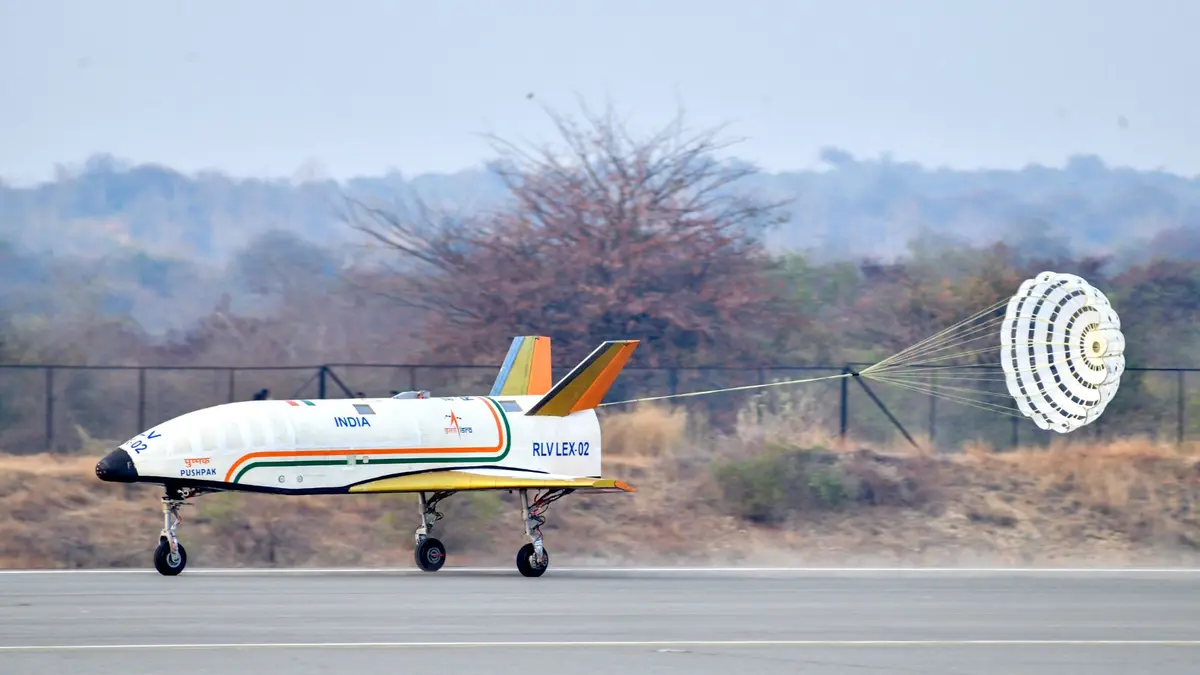
India has once again achieved a major milestone in its ambitious reusable launch vehicle (RLV) program. The winged vehicle, nicknamed Pushpak (RLV-LEX-02), successfully landed on a runway in Karnataka after completing a test flight.
The Chairman of ISRO, S. Somanath, praised the mission for its "excellent and precise" performance. ISRO proudly announced another successful achievement in India's space journey.
During this real-world simulation, Pushpak was released from an Indian Air Force helicopter and autonomously landed on the runway, replicating the conditions of a spacecraft returning from orbit. According to ISRO, the vehicle independently approached the runway, made the necessary adjustments during descent, and completed a precise landing. It then came to a stop using its brake parachute, landing gear brakes, and nose-wheel steering system.
This marked Pushpak's third successful flight, demonstrating its ability to perform autonomous landings even under challenging conditions. Although it may take several more years before the vehicle is used in operational missions, each successful test brings India closer to its goal of making space launches more affordable, efficient, and sustainable.
This achievement is a source of pride because ISRO has successfully accomplished a task that was extremely challenging. The mission proves that with dedication, innovation, and perseverance, even the most difficult goals can be achieved.
RLV-LEX-02 Experiment
ISRO once again demonstrated its technological excellence when Pushpak (RLV-TD), the winged test vehicle, executed a precise autonomous landing after being released from an off-nominal position by an Indian Air Force helicopter.
The Future Potential of Pushpak
Vehicles like Pushpak could revolutionize future space operations. In addition to reducing launch costs, they may one day be used to refuel satellites in orbit, retrieve malfunctioning satellites, and perform repair missions. Such capabilities could also help reduce the growing problem of space debris.
Ten Years of Research, Testing, and Development
The Pushpak project reflects India's long-term commitment to innovation in space technology. Over the past decade, numerous scientists and engineers have contributed to its development.
In 2016, the RLV technology demonstrator was launched from Sriharikota and successfully completed its planned flight before landing on a simulated runway in the Bay of Bengal. However, the vehicle was not recovered and eventually sank into the sea.
Another major milestone was achieved on April 2, 2023, at the Chitradurga Aeronautical Test Range. During the RLV-LEX experiment, an Indian Air Force Chinook helicopter carried the winged vehicle to a designated altitude before releasing it. Pushpak then autonomously navigated and landed safely without any issues.
With successful demonstrations in 2016, 2023, and 2024, Pushpak highlights India's steady progress in reusable space transportation technology.
Inspired by the mythical Pushpak Viman, the flying chariot described in ancient Indian literature, India's reusable space shuttle program reflects the nation's vision of self-reliance and technological leadership in space exploration. Supported by significant government investment and continuous innovation, India aims to join the select group of nations leading the development of reusable launch systems.
Source: ISRO and the Indian Air Force (IAF)